Passing of Jean Duminy, architect, urban planner, watercolorist and leading figure in the École des Arts et Métiers.

Former teacher and Chairman of the Board of Directors

Passing of Jean Duminy, architect, urban planner, watercolorist and leading figure in the École des Arts et Métiers.
  • School life
Jean Duminy's career and success, marked by the diversity of his activities as an elected official, teacher, architect, urban planner and engineer, have been nourished by the particularities of these functions and professions, and, as a teacher, he has been able to pass on...
A teacher from 1966 to 1994, Chairman of the Management Board of the Architecture Teaching Unit in 1979, and Chairman of the Board of Directors ofENSA Normandie 1979 to 1994, Jean Duminy had a profound impact on the history of architecture education in Rouen through his proposals for educational reforms.
Multidisciplinarity: he defends it and practices it in the exercise of his functions. Whether at SCEC with its 3 partners, or at SOREPA and then as Managing Director of URBA CONSEIL. He introduces this multi-disciplinary approach to urban project development, enriching and giving meaning to the "contrasting scenarios" method he has developed throughout his career.
This method, which aims to define strategic and co-constructed invariants in order to arrive at a final scenario that is politically accepted and shared, is being developed in France and abroad. These include The Oise Valley development plan, the Breton coastline, the Moravia-Silesia region in the Czech Republic, Uruguay and Turin... This method also integrates consultation at the heart of projects. It takes into account the visions of all stakeholders (elected representatives, local residents, key players, technicians, institutions, etc.), so that projects can be implemented more easily in a climate that is calmer, better understood and more legitimate. In this respect, the CRAN GEVRIER town center project has been a benchmark for over 20 years, despite the difficulties encountered and adaptations to be taken into account.
His skills were also widely recognized by DATAR, which appointed him French expert to the European Commission on coastal development policies. Within this framework, he wrote the European coastal development guide and was appointed expert for the city of Venice to find solutions to reduce the city's sinking...

All these activities, combined with a passion for this profession and a thirst for passing it on, led Jean Duminy to create the Institut Européen d'Aménagement et d'Architecture (INEAA) in 1988, and to offer post-graduate training within a network of numerous European higher education and research establishments in the fields of regional planning, urban development and architecture, to learn THE method, HIS METHOD of integrated and participative urban design... In short, a profession that requires a mastery of the systemic, creative, forward-looking and iterative approach! But it's also a passionate profession, because of its complexity: the interplay of players, multi-scalarity, political stakes, regulatory constraints and developments, technical and environmental constraints... A profession which, by its very nature and objective: to interact and modify the Cities of tomorrow for us and our children... it's essential to be both convinced and humble at the same time.

In retirement, Jean Duminy rediscovered "the right to create", as he liked to say. A remarkable watercolorist, in 2001 he escaped to Tuscany to pick up his brushes again and devote himself fully to painting. Necessarily, his watercolors reflect a rich, intense, multifaceted and contrasting life, enriched by his many travels.

Christelle Oghia, Laurent Protois and Stéphane Rioland

Published on December 7 2023

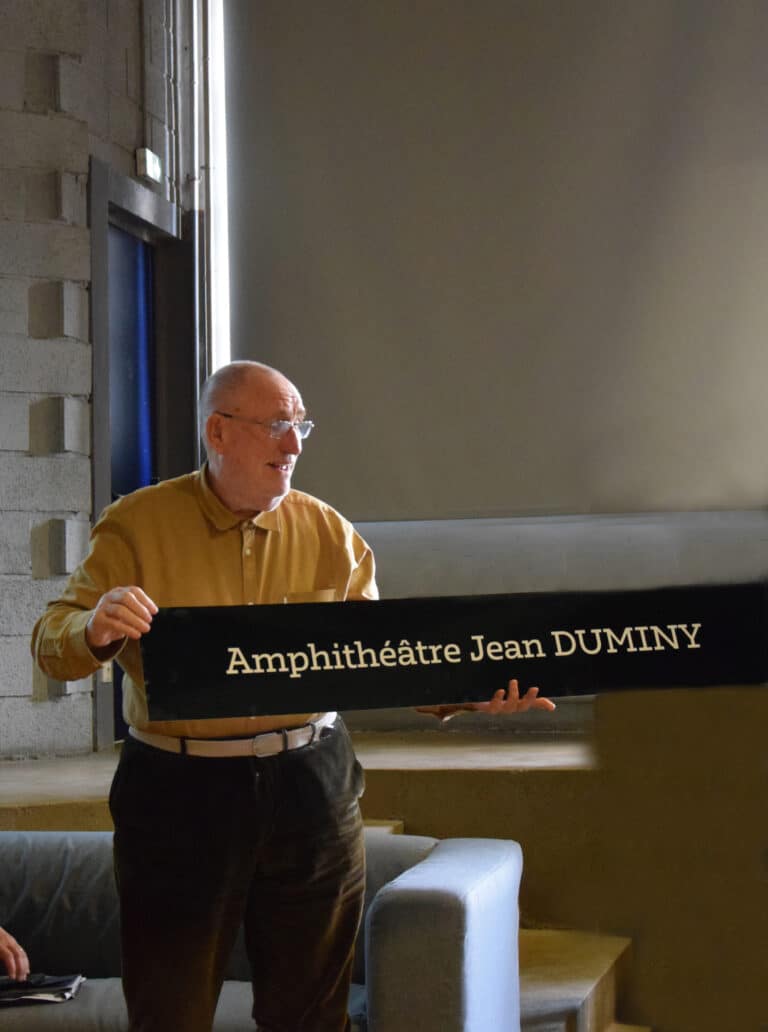
Jean Duminy,

with the plaque in the amphitheatre
bearing his name at the
6th HEnsA20 seminar in May 2019

© ensa normandie