
Thesis Defense – Living in the Zone
Misia Forlen
- Search
On Wednesday, December 8, 2026, at 10:30 a.m. and again at 2:30 p.m., Misia Forlenwill defend her doctoral dissertation titled “Living in the Zone: Observing, Filming, and Understanding the Daily Practices of Mobile Workers in Special Economic Zones (SEZs).”
This doctoral dissertation was completed at the University of Le Havre Normandy as part of the RADIAN program (Research in Art, Design, Innovation, and Architecture in Normandy), under the supervision of Arnaud Le Marchand (CNRS UMR IDEES 6266 – University of Le Havre Normandy) and Bruno Proth (ATE – École Nationale Supérieure d’Architecture de Normandie).
The defense will take place on Wednesday, July 8, 2026, in two parts:
– at 10:30 a.m.: presentation of a film and cartographic installation at the Le Havre Port Center (panoramic room), Terminal de la Citadelle, 76600 Le Havre. Refreshments will be served starting at 10:15 a.m.
– at 2:30 p.m.: thesis defense, at the University of Le Havre Normandy (International Affairs Building, Lecture Hall 4), 25 rue Philippe-Lebon, 76600 Le Havre.
Jury member
Marc BERNARDOT, Full Professor, Aix-Marseille University, Thesis Advisor
Florence BOUILLON, Associate Professor, Paris 8 University Vincennes St-Denis, Examiner
Catherine DESCHAMPS, Full Professor, ENSA Paris La Villette, Thesis Advisor
Lucinda GROUEFF, Assistant Professor, ENSP Versailles, Examiner
Anne JARRIGEON, Associate Professor (HDR), Gustave Eiffel University, Examiner
Laëtitia OVERNEY, Full Professor, University of Le Havre Normandy, Chair of the Committee
Thesis Advising
Arnaud LE MARCHAND, University Professor, University of Le Havre Normandy, Thesis Co-Advisor
Bruno PROTH, University Professor, ENSA Normandie, Thesis Co-Advisor
Thesis Abstract
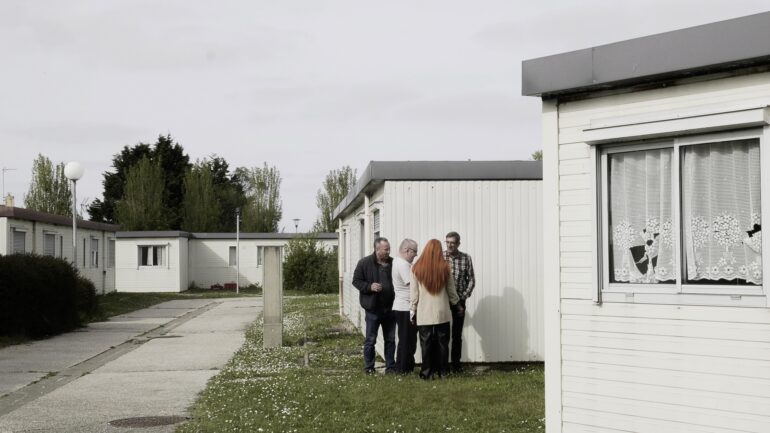
“Habiter la zone” is a research-creation project that examines the daily practices of mobile workers in Special Economic Zones (SEZs), models of free trade zones that function as economic and fiscal enclaves. At the intersection of the social sciences, architecture, and the visual arts, this dissertation explores forms of creative expression that, in turn, inform research on inhabiting spaces, in relation to changes in work and industrial territories. Developed within the RADIAN doctoral program (Research in Art, Design, Innovation, Architecture in Normandy), this doctoral project is structured around several components: a theoretical dissertation, audiovisual works, and a field journal in the form of an interactive, evolving online map that allows for the spatial representation of observations, reflections, and hypotheses, as well as images and sounds, resulting from this hybrid process of research and creation.
Rooted in an empirical, field-based approach, the research documents little-known situations of housing insecurity in and around industrial employment hubs in both France and Poland. It takes as its starting point a study of Port-Jérôme-sur-Seine, where a project has been in place since February 2018 . This unique territorial and economic context is then placed in perspective with other contexts exhibiting similar characteristics, in order to establish connections and comparisons at various scales—metropolitan, regional, and European. The filmmaking approach must therefore constantly adapt to the specific challenges and constraints of the various study sites: at a Grand Paris Express construction site, it allows for an examination of the processes of metropolization along the Seine corridor, as well as the constraints associated with filming and distributing a documentary; in Flamanville, footage shot in various everyday settings frequented by people working on the EPR construction site allows us to examine relationships with family and the role of women in displacement; in Poland, YouTube videos created by foreign female workers offer new perspectives for considering the digital living space as a meaningful scale of analysis. Audiovisual productions, viewed as an active process of research and creation, help address the challenges of representation linked to the invisibility of these areas, as well as of those who live there and shape them.
Keywords: ways of living, daily life, blue-collar work, geographic mobility, industrial region, special economic zone, gender, video, research-creation.
Image: Living in the Area © Misia Forlen