
Thesis Defense – Agriculture Is a Battlefield, and Architecture Bears Witness to It
Guillaume Nicolas
- Search
Monday, October 12, 2026 , at 2:00 p.m., in the Duminy Lecture Hall, Guillaume Nicolas will defend his doctoral dissertation titled “Agriculture Is a Battlefield, and Architecture Bears Witness: An Investigation into the Transformations of Norman Clos-Masures.”
This doctoral dissertation was prepared at the ATE laboratory under the supervision of Valéry Didelon, professor, ENSA Normandie, ATE.
Jury member
Isabelle CHESNEAU, Professor, ENSA Paris-Malaquais (Reviewer)
Sébastien MAROT, Professor, ENSA Paris-Est (Reviewer)
Matthieu CALAME, Ph.D. (Examiner)
Sandra FIORI, Associate Professor, ENSA Lyon (Examiner)
Philippe MADELINE, Professor, University of Caen Normandy (Examiner)
The defense will be streamed live via videoconference HERE
Thesis Abstract
With the widespread adoption of motorized machinery and chemical inputs, the second agricultural revolution of modern times profoundly transformed farmers’ practices after World War II. Today, in an era of ecological disruption and geopolitical instability, the French government is promoting a third revolution—one centered on digital technology, robotics, and genetics. Co-managed by the state and the dominant farmers’ union, the FNSEA, these modernization policies are affecting the structure of traditional farm operations, where most farmers continue to work. Yet, a segment of the agricultural community is concerned about the consequences for the profession and, more broadly, for rural communities. The Confédération paysanne in France and La Via Campesina internationally advocate for different collective choices and embody a structured alternative, both technically and socially. Agriculture has now become a battleground, polarized between an industrialized path and a contemporary peasant path. The hypothesis of this research is that architecture reflects an ideological clash that goes beyond the mere technical-economic orientations of farms (OTEX) as defined by INSEE. To study this phenomenon, the field survey conducted here among some forty farmers in Normandy establishes a new category—the political orientation of farms (OPEX)—and analyzes how this influences the architecture of farmsteads. More generally, this research uncovers the reasons that, beyond purely utilitarian considerations, dictate how farmers shape their built and landscape heritage. The farms observed all belong to the same historical type found in the Pays de Caux—the “clos-masure”—which possesses both a strong regional identity and a certain flexibility for adaptation. The study of the transformations of these vernacular buildings and landscapes reveals the changes currently underway and helps to clarify what architecture says about agriculture—and sometimes also what it does to it—on functional, material, and aesthetic levels.
Keywords: industrial agriculture, small-scale farming, agricultural architecture, vernacular, heritage, decision-making, clos-masure, Normandy, survey, controversy
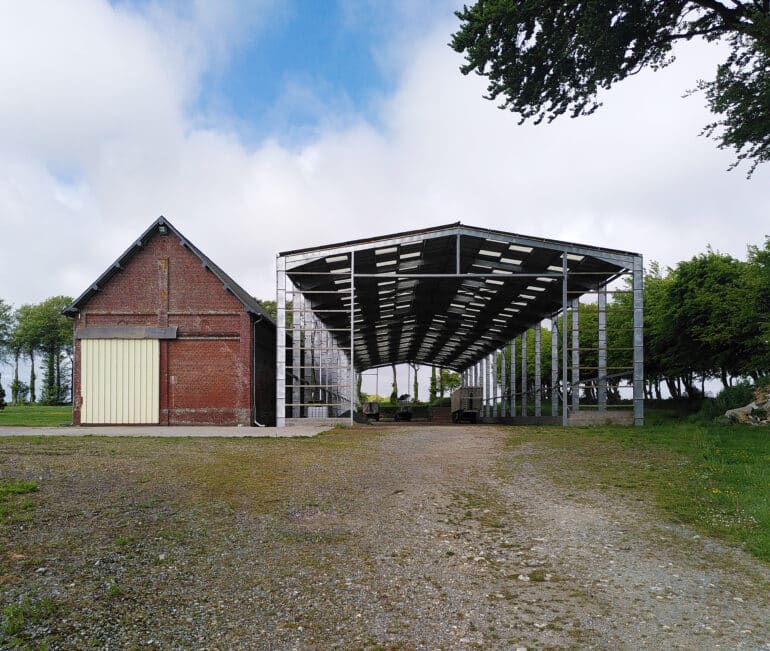
Photo: Agricultural barn under construction in a "clos-masure" © Guillaume Nicolas