
Thesis defense - Thought and the instituting praxis of the common
by Miléna Koutani
- Search
On Friday, December 12, at 2 p.m. in the Jean Duminy lecture hall, Miléna Koutani will defend her doctoral thesis entitled "Thoughts and praxis establishing the common good. A third way for urban alternatives."
This doctoral thesis was prepared at the ATE laboratory, under the supervision of Bruno PROTH, professor, ENSA Normandie, ATE.
Jury member
Silvana Segapeli, University Professor, ENSA Saint-Etienne (Rapporteur)
Mathias Rollot, Senior Lecturer HDR, ENSA Grenoble (Rapporteur)
Catherine Deschamps, University Professor, ENSA Paris-La Villette (Examiner)
Florence Bouillon, Associate Professor, Université Paris 8 (Examiner)
Arnaud Le Marchand, Maître de conférences HDR, Université du Havre (Examiner)
A live webcast of the presentation can be viewed by clicking HERE.
Summary of thesis
Since the 2000s, the concept of the commons has come to dominate a number of disciplinary fields, and today goes beyond its initial framework, developed by the pioneering work of Elinor Ostrom. Characterized as co-activity between individuals within a collective, the commons also represents a third way in the production of space, beyond state action and market constraints. This doctoral research focuses on the work of the (faire-)commun, integrated into the urban and architectural field, where new cooperative, alternative and sometimes radical modes of living are being experimented with.
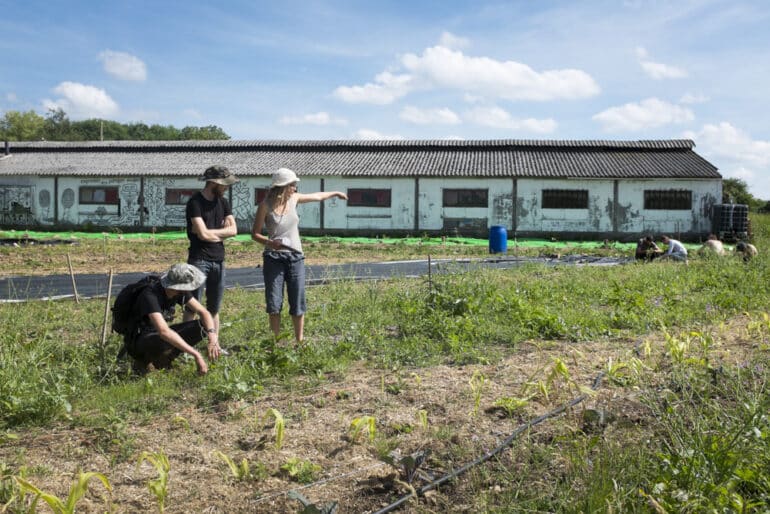
To do so, we draw on various fields of investigation in Seine-Maritime: the follow-up to the occupation of the Foyer Sainte-Marie by the Jardins Joyeux collective, linked to other past struggles and experiments underway in the Rouen metropolitan area (Ferme des Bouillons, Tiers-lieu du 40 and the Grenouille squat). The study of other structures, such as Hangar Zéro in Le Havre, has also enabled us to delve deeper into the stages of conditioning the common, in relation to a renewed right to the city: from the opening of a third space, to the challenges of peer governance, via the definition, identification and transformation of an "interwoven self" within a collective action. At the heart of a movement of instituting resistance, these fields have revealed antagonistic interests in the territory, as they challenge the absolute right of ownership, granting prevalence to the social destination of a space, its access, use and mutualization. Against the backdrop of a new climate regime and the emergence of new enclosures, these conflict zones allow us to question our needs, desires and renunciations.
By defining the common and its architectural and urban implications on the one hand, and assessing its ramifications within alternative projects on the other, this research aims to analyze new forms of mutualistic, supportive and cooperative links, likely to give rise to, structure and stimulate unprecedented urban transformations.
visual : Occupation of the Bouillons Farm in 2015. Photo © Bouillons Terres d'Avenir