
As the first comprehensive post-master’s program at ENSA dedicated to the reuse of materials in construction, the DPEA (Diplôme Propre aux Ecoles d’Architecture) REBOND trains professionals to design, transform, and build in innovative ways.
A comprehensive two-semester program
The REBOND DPEA program trains experts capable of designing sustainable projects by making use of existing materials and resources.
Combining theory, practice, and innovation, this comprehensive program addresses the current and future environmental challenges facing the construction industry.
Supported by a strong network of professional partners, it facilitates the integration of graduates and actively contributes to the growth of the reuse sector.
Objective
The REBOND DPEA applies the principles of the circular economy to architecture. The availability of materials serves as the starting point for a renewed approach to architectural design. The program combines assessment, careful removal, reconditioning, and regulatory considerations for the reuse of materials in architectural projects.
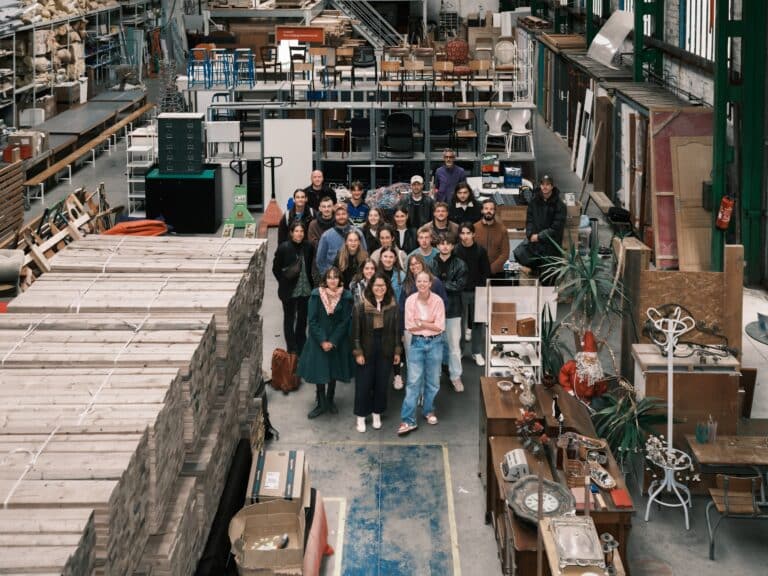

Programme
An intensive two-semester course
Duration: 1 year
Location: Rouen – Darnétal (primarily), with key locations in Le Havre and the Paris region.
- 10 specialized theoretical modules focusing on the material cycle
- 1 international study trip
- 1 real-world project workshop
- 1 four-month professional internship
- 1 research thesis and defense
Led by some thirty professionals and experts in the field, the training program offers a comprehensive immersion in the reuse ecosystem.
Supervision
The program is led by three associate professors fromENSA Normandie: Julien Choppin, architect, co-founder of the Encore Heureux firm, and curator of the Matière grise exhibition at the Pavillon de l’Arsenal; Adrien Henocq ( partner at the Belus & Hénocq architects firm, specializing in bio-based construction); and Jennifer Didelon ( heritage architect specializing in the assessment and renovation of existing buildings). The program is complemented by contributions from some thirty external professionals recognized for their expertise in the field of reuse (demolition contractors, lawyers, technical inspectors, etc.).
Semester 1
- 10 modules, each lasting 2 days.
- 1 study tour in Europe to meet pioneers in the field of reuse.
- Project Workshop (20 days) – Real-world scenarios involving local stakeholders.

List of Theoretical Modules – Semester 1
Module 1: From Raw Material to Waste
Life cycle of building materials.
Upstream phase (production, distribution, prescription) and downstream phase (waste).
Construction and demolition waste management methods, classifications, and disposal options.
Materials recycled from waste.
The impacts of material extractivism: quarries, landfills, and the landscapes they shape.
Module 2: Stories of Reuse Practices
A historical perspective on appropriation practices.
Antiquity, the Middle Ages, the modern era.
Looting, appropriation, collections.
American counterculture.
Cultural history. Production chains.
Module 3: The Reuse Ecosystem
A Renewal of Circular Material Practices in the Contemporary Era
Network of stakeholders and pioneers. Engineering firms, companies, platforms, institutions.
Maps, directories, networks.
Awards, certifications.
Module 4: Conducting an Operation
Incorporating reuse into construction operations.
Roles of stakeholders (project management consultant, client, project management office, contractors) and procurement (design and construction).
Phasing of operations.
The circular economy, carbon footprints.
Feedback on experiences.
Module 5: Regulations, Insurance, and Warranties
Changes in the legal landscape. Laws and regulations.
Uncommon techniques. Technical inspection.
Test protocols, characterizations.
Module 6: Diagnosing
Conservation of existing resources.
PEMD Assessment, Resource Assessment.
Digital tools.
Technical feasibility of selective demolition.
Module 7: Disassemble, Refurbish, Resell
Careful removal.
Logistics, warehousing.
Physical platforms, digital platforms.
Module 8: Construction Sites and Supply Chains (Structural Work)
Inert waste.
Concrete, brick, stone.
Metal framing, wood framing.
Professional standards.
Module 9: Resources and Industry Sectors (Finishing Work)
Plaster, insulation.
Carpentry, plumbing fixtures, radiators.
Upcycling, design.
Module 10: Urban Metabolism
The flow of goods into and out of a region.
Cross-site management, mapping.
Management of excavated material.

Semester 2
- 4-month professional placement: internship or return to the workplace
- Writing a thesis
- Defense before a jury
Objective: to consolidate expertise and develop professional positioning.
Diploma
Participants who have completed and successfully passed the entire program will receive the Diploma in Architectural Studies (DPEA REBOND).
Admission requirements
The DPEA REBOND training program is open to:
- architects, engineers, and candidates with a five-year degree in construction, environment, or engineering.
Admissions Process:
- Call for Applications
- Pre-screening of Applications
- Online one-on-one interview (20 minutes)
- Publication of Results
- Administrative Registrations
Applications are subject to a selection process. Participation in the program and the start of the course will not be finalized until the selection committee has approved the applicants and the admission process has been completed.

Registration fees
The registration fees include registration for the training course, travel to the training locations, and travel within Europe. These items do not apply to the "à la carte" modules.
- Course fee: €3,900
- Reduced rate for recent ENSA graduates (graduates of an architecture school under the Ministry of Culture who have graduated within the last two years as of the course start date): 2,900 €
- Special rate for recent graduates ofENSA Normandie academic year 2024–2025 or 2025–2026): €1,700
- "À la carte" modules (participation in one or more modules without completing the entire program—does not lead to a degree): €500 per module
You may pay in three installments at no additional cost as part of a self-financing plan. If you wish to take advantage of this option, please be sure to notify the department at formation@rouen.archi.fr.

Start of the 2026–2027 School Year
See you on September 28 and 29 at theEnsa Normandie.
Further information will be provided shortly.
Contact: formation@rouen.archi.fr
Frequently asked questions
When are the training sessions?
In the first semester: Mondays (projects), Tuesdays, and Wednesdays (modules). Please note that because Wednesday, November 11, is a holiday, the second day of the module will take place on Thursday, November 12, 2026.
In the second semester: internship or return to the workplace (schedule to be determined with the employer)
Is international travel required?
The international trip is an integral part of the program. For this first year, it will take place from October 5 to 8, 2026, in Belgium and the Netherlands (you may want to allow for one or two additional days for travel).
Is international travel required?
The international trip is an integral part of the program. For this first year, it will take place from October 5 to 7, 2026, in Belgium and the Netherlands (please allow for one or two additional days for travel, if necessary).
When does the new school year start?
The new school year begins on September 28, a few days before the trip to Europe.
What does the first semester look like?
The first semester will run from September 28, 2026, to January 20, 2027. The school will be closed during the Christmas break. There will be no classes the week of October 26, 2026.
What does the second semester look like?
It will be dedicated to the internship or the return to work. The specific details of its organization should therefore be discussed with the employer.
What certificate will I receive upon completion of the program?
At the end of the year, you will be awarded a Diploma Specific to Architecture Schools (DPEA). This diploma will certify your specialized skills in the field of reuse.
What are the requirements for earning the DPEA REBOND diploma?
The evaluation of the training program and the awarding of the DPEA REBOND diploma are carried out by:
- attendance at the various modules
- the distribution of the summaries of the case study results
- the completion of an internship (or a return to the workplace), followed by the defense of a thesis before a panel at the end of this period.
