
"The (Un)Visible(s)" by Jade Apack
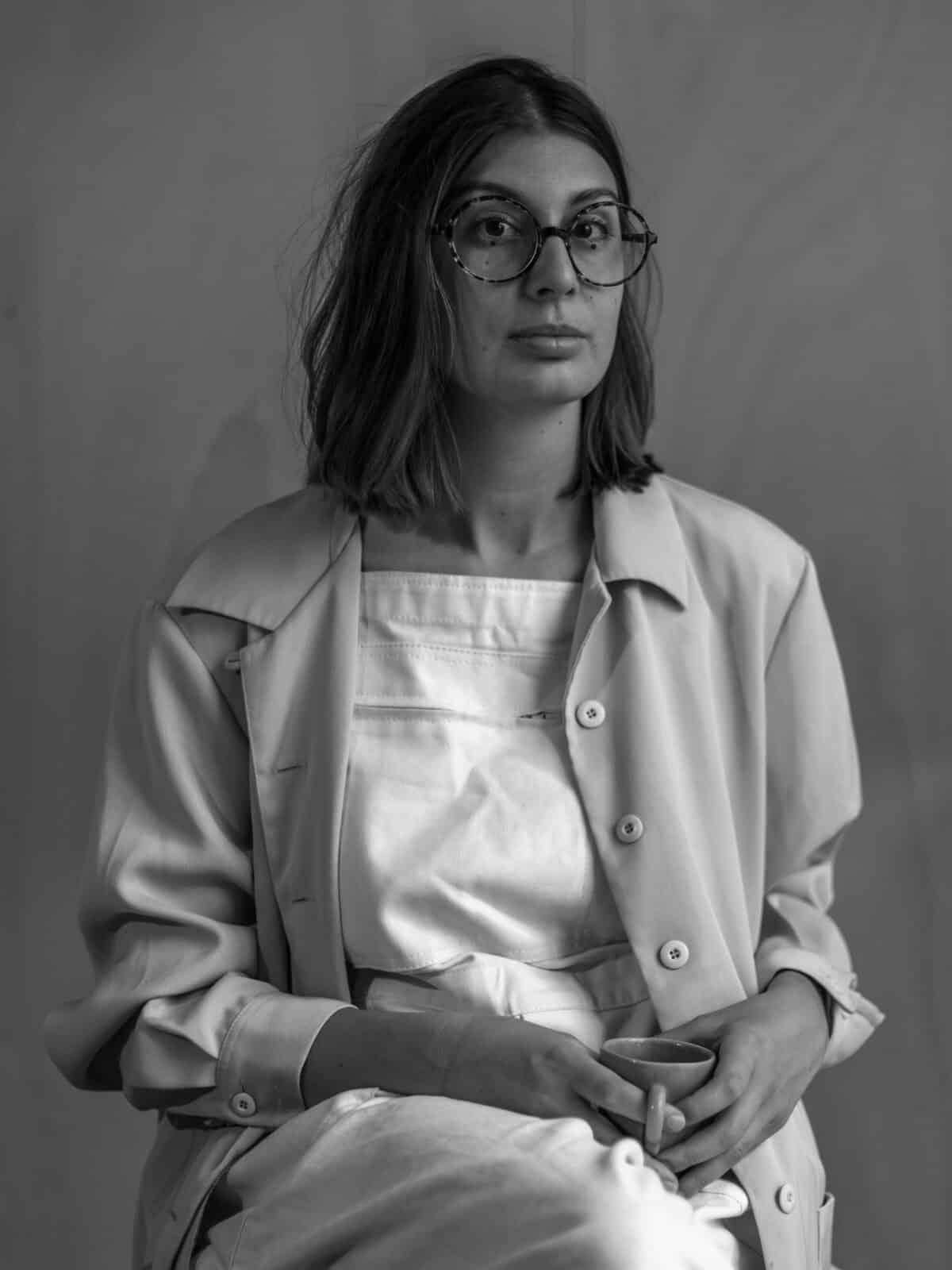
Jade Apack is an architect and artist. She explores the transformation of territories by contrasting human history with long geological time. Co-founder of the Lost&Find association, she is studying SPEAP in 2024 at Sciences Po Paris, while also being a LINA laureate. She participates in residencies, such as at the Cité des Arts in 2025, Les Arches Citoyennes in 2024, and EoFA, Geneva in 2021. Her work has been exhibited at the Cartography Biennial, Lille, 2024, and at the Pavillon Sicli, Geneva, 2021.
Image ©Marine Foni
Workshop – Moving minerality
The workshop aims to explore the plasticity of minerals that are mistakenly thought to be inert.Taking advantage of the geologically rich basin of Rouen, students will develop a material and sensory exploration of its sands, alluvial deposits, limestone, chalk, flint, salts, clays, and other conglomerates.
Returning to the basics of construction resources and raw materials, the workshop will take on the feel of a laboratory, with projects drawing on an awareness of the cycle of material transformation, long geological timescales, and the origins and agency of resources in the landscapes where they are formed. At the end of the semester, the resulting projects will form architectural interventions along a landscaped walkway.

"The Phenomenology of the Past" by Carl Arvidsson
I am a Swedish freelance architect based in Normandy since 2020, working with old buildings and rural architecture. My practice lies at the crossroads of heritage and contemporary architecture. My career has taken me to Scandinavia, Switzerland, and France. I am currently enrolled in the final semester of the DSA Architecture and Heritage program at the École de Chaillot in Paris.
Workshop – “The Phenomenology of the Past” – A workshop on the perception of heritage
Through the study of representative examples of built heritage, the workshop will teach students drawing, surveying, photography, writing, model-making, and woodworking. Through this approach, the studio aims to help students better identify and express their perceptions of the built environment.
The course will also explore various theories of conservation and restoration, from Viollet-le-Duc to John Ruskin, as well as the foundations of theoretical frameworks such as Alois Riegl’s system of values and Cesare Brandi’s theory of restoration.
This practical and theoretical course offers a sensitive and respectful approach to working with existing architecture.
“The Heritage of the Infra-Ordinary” by Lucas Monsaingeon
Architect and doctor of architecture and urban planning, Lucas Monsaingeon has been working as a project manager for over fifteen years as a partner and project director at the Philippe Prost architecture firm. He has led award-winning projects in France and internationally, such as the Anneau de la Mémoire (Ring of Remembrance) and the renovation of the Cité des Électriciens. At the same time, he regularly lectures at architecture schools and conducts research. His thesis, entitled "Project development in the mining basin of Nord and Pas-de-Calais. Territory, architecture & post-industrial heritage: from dead land to living soil," explores the challenges and levers of architectural transformation in a post-industrial territory.

Workshop – “Infra-ordinary manifesto, for endotic architecture,” tribute to Georges Perec (1936–1982)
“Newspapers cover everything except the day-to-day. […] What’s really happening—what we’re experiencing—the rest, all the rest—where is it? What happens every day and keeps coming back every day—the mundane, the everyday, the obvious, the commonplace, the ordinary, the background noise, the routine—how do we account for it, how do we examine it, how do we describe it? […] Describe your street. Describe another one. Compare them. Take inventory of your pockets and your bag. Ask yourself about the origin, use, and future of each object you take out of them. Question your teaspoons. What’s under your wallpaper?” Georges Perec, *The Infra-Ordinary*, 1989
This workshop invites students to conduct a collective investigation into situations within sight, within a 500-meter radius ofENSA Normandie. This "attempt to exhaust" a given space, with a descriptive and transformative aim, lies at the intersection of architectural and urban scales. The methodical approach aims to inventory, describe, and question the 1,363 built elements present around the school, without hierarchy or prejudice: hangars, apartment buildings, single-family homes, historical remains, public facilities, electrical pylons, mills, bus stops, traveler areas, etc. It combines digital mapping techniques, surveying to see with one's own eyes, and traditional survey techniques to produce localized knowledge.
In line with Georges Perec's Oulipian approach, this workshop is based on the application of a strict protocol, where constraints and randomness become a source of creativity. Mathematical games, geometry, statistics, and chance will thus be used to process the series and reduce the corpus. Students will then be invited to consider problematic situations, propose transformations for these places, and explore their possible futures.