Thesis defense - Damien Renault

Training local elected officials in architecture, or architecture as political education
5 Oct 2023
Thesis defense - Damien Renault
  • Search

14h00 - Jean Duminy Amphitheatre -

Damien RENAULT will submit his doctoral thesis entitled "La formation des élus locaux à l'architecture ou l'architecture comme éducation politique".

This doctoral thesis was prepared in the ATE laboratory, under the supervision of Caroline MANIAQUE.

Jury members
Véronique BIAU, Architecte-urbaniste en chef de l'État, ENSA de Paris-La-Villette, LET-LAVUE, rapporteur
Pierre CAYE, Director of Research, ENS Ulm, Centre Jean-Pépin, Rapporteur
Jean-Charles CHABANNE, University Professor, ENS Lyon, Institut français de l'éducation, ECP, LIRDEF, examiner
Arnaud DUTHEIL, Architect, examiner
Marc FROCHAUX, Architect, examiner


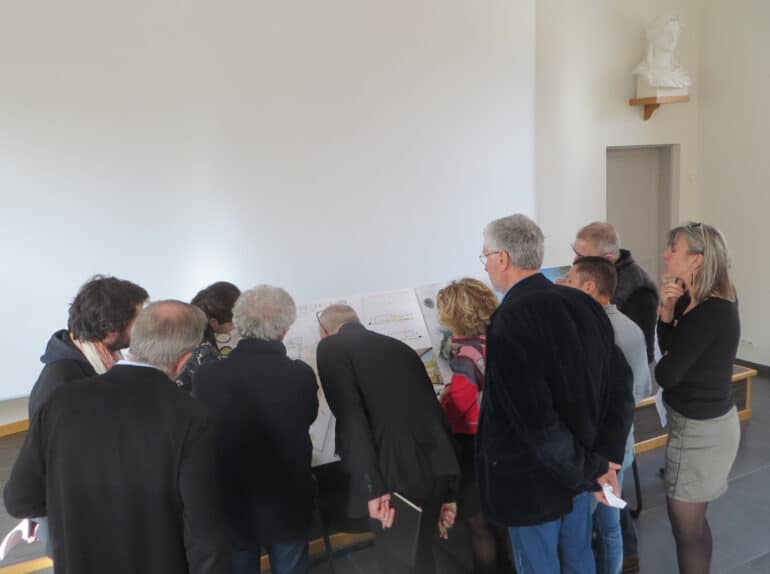
visual © Damien Renault

Training local elected officials in architecture, or architecture as political education

Damien Renault

 
In response to political demands for local elected officials to be trained in architecture by existing advisory, mediation and training institutions, and given the anthropological and cultural difficulties raised by these demands, this thesis raises the question of edilitary training opportunities: when, in what situations, on what occasions, in what circumstances, formal and informal, are local elected officials likely to "encounter" architecture, to have a "formative contact" with it?
 

Two avenues have been pursued: first, based on the model of training engineering, the referentialization of edilitary activities and skills (I); then, based on the analysis of teaching practices, the definition and modeling of a "teaching object" (II). The research is based first on urban planning law and architectural criticism (I), then on a corpus of (hypothetically) formative situations: advisory, mediation and (explicitly) training situations (II). The thesis thus highlights the fundamental capacity (in an edilitary frame of reference) to pay attention to, appreciate and judge construction (I), then shows how consulting architects, mediators and trainers exercise this capacity - their own and that of their audience(s) - through the "architectural reading" of projects and sites (II).

Through this didactic proposal, defined as a set of reflective operations or spiritual exercises contributing to the appropriate judgment of construction, the thesis intends to contribute to research: on the one hand, in the field of architecture, by reintroducing (the relationship to) architecture into "processual" research and initiating an anthropological approach to the profession and the discipline; which, on the other hand, falls within the field of education and training sciences, more precisely within the horizon of ergo-didactics, seeking in teachers' "professional gestures" the foundation of taught knowledge.

The proposal also responds to the initial political demand, presenting itself as a tool for improving (or didactizing) current architectural advisory and mediation practices, and for professionalizing advisors and mediators.
Finally, going beyond this demand, the survey allows us to consider architectural advisory, mediation and training as a means of political education for elected representatives.