
Thesis Defense – The Teaching of Construction to Architects Between 1920 and 1970 in France and Germany
Gabriel Bernard Guelle
- Search
On Tuesday, November 24, 2026 , at 2:00 p.m., in the Duminy Lecture Hall, Gabriel Bernard Guelle will defend his doctoral dissertation titled “The Teaching of Construction to Architects Between 1920 and 1970 in France and Germany: Defining and Reforming the Architect’s Relationship with Technology and Engineers.”
This doctoral dissertation was prepared at the ATE laboratory under the supervision of Caroline Maniaque, professor emerita, ENSA Normandie, ATE, and with the co-supervision of Christel Palant-Frapier, associate professor, ENSA Paris-Val-de-Seine, EVCAU.
Jury member
Valérie Nègre, Professor, University of Paris 1 Panthéon-Sorbonne, rapporteur
Estelle Thibault, Professor, École nationale supérieure d’architecture de Paris-Belleville, rapporteur
Pierre Chabard, Associate Professor, École nationale supérieure d’architecture de Paris-La Villette, examiner
Jörn Garleff, Associate Professor, École nationale supérieure d’architecture de Saint-Étienne, examiner
Corinne Jaquand, Professor, École nationale supérieure d’architecture de Paris-Belleville, examiner
Antonella Mastrorilli, Professor, École nationale supérieure d’architecture et de paysage de Lille, examiner
The defense will be streamed live via videoconference HERE
Thesis Abstract
From 1920 to 1970, the architecture departments at the École nationale supérieure des beaux-arts in Paris and the École technique supérieure in Munich reformed their construction curricula in response to the technical, institutional, and professional changes that took place in France and Germany during that period. Despite these reforms, French students and practicing architects continually criticized their construction curriculum for being out of touch with current architectural trends and the realities of professional practice, even though they received more in-depth training in this area than their German counterparts. While recent research on architecture education in France during the 20th century has examined its successive transformations and the reasons behind the collapse of the École nationale supérieure des beaux-arts model in 1968, few scholarly works have focused specifically on construction education, and none have addressed the criticism directed at it. To understand this criticism, this dissertation therefore examines the definition of the architect’s technical knowledge as conveyed through construction education, in light of the institutional and professional expectations it is meant to meet. Through a comparative historical approach, it examines the content, tools, and methods of construction courses taught to architecture students at the École nationale supérieure des beaux-arts in Paris and the Technical University of Munich, in relation to the technical, institutional, and professional contexts in France and Germany. She thus demonstrates the role of construction education in defining technical knowledge specific to architects and in shaping their relationship to technology and engineers.
Keywords: architecture education, architect, engineer, France, Germany, 20th century, technology, École nationale supérieure des beaux-arts, Technische Hochschule München, history of architecture, history of education, 1920–1970, Paris, Munich
Images:
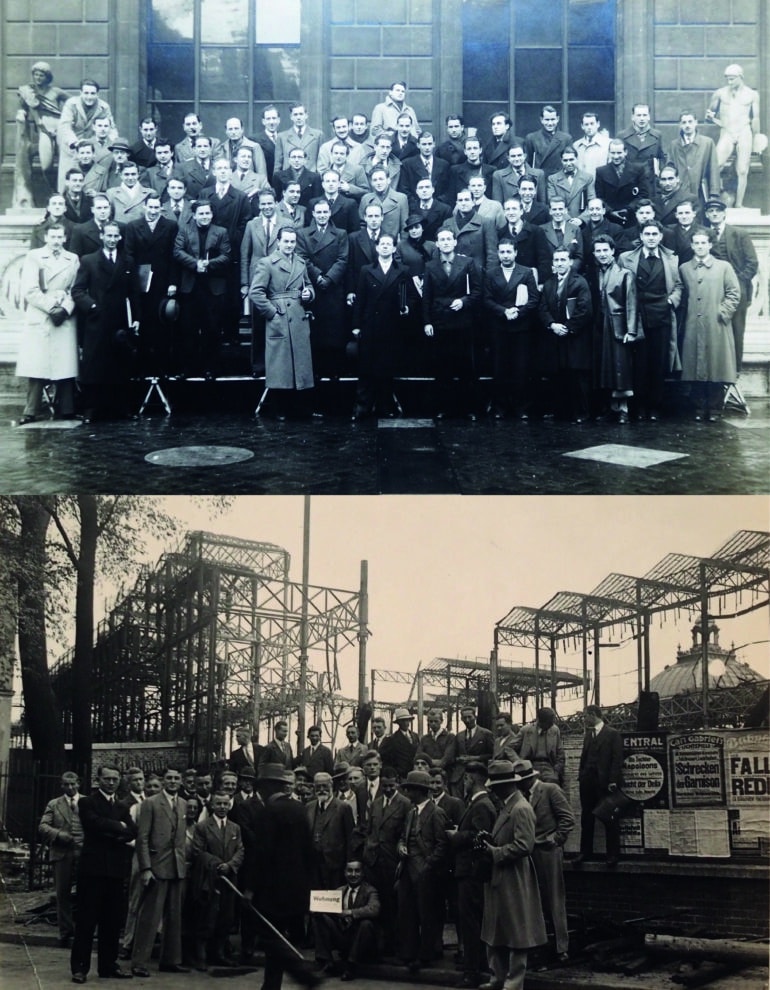
(top) François Vitale, professor of Construction at the École nationale supérieure des beaux-arts in Paris, with his students in front of the school’s library, January 1937. Personal archives of Françoise Boudon.
(bottom) Emil Edler von Mecenseffy, professor of Building Construction at the Technical University of Munich, visiting a construction site with his students, 1931. Archive of the Architecture Museum at the Technical University of Munich, Franz Hart Collection, har-404-1001.