The ATE laboratory newsletter

Output - ATE Workbooks n°3

You can find the latest newsletter of the ATE laboratory in the publications kiosk and by clicking HERE. This one is mainly dedicated to the PhD students of the ATE laboratory.

Published on

from 9.30 a.m. to 1 p.m.

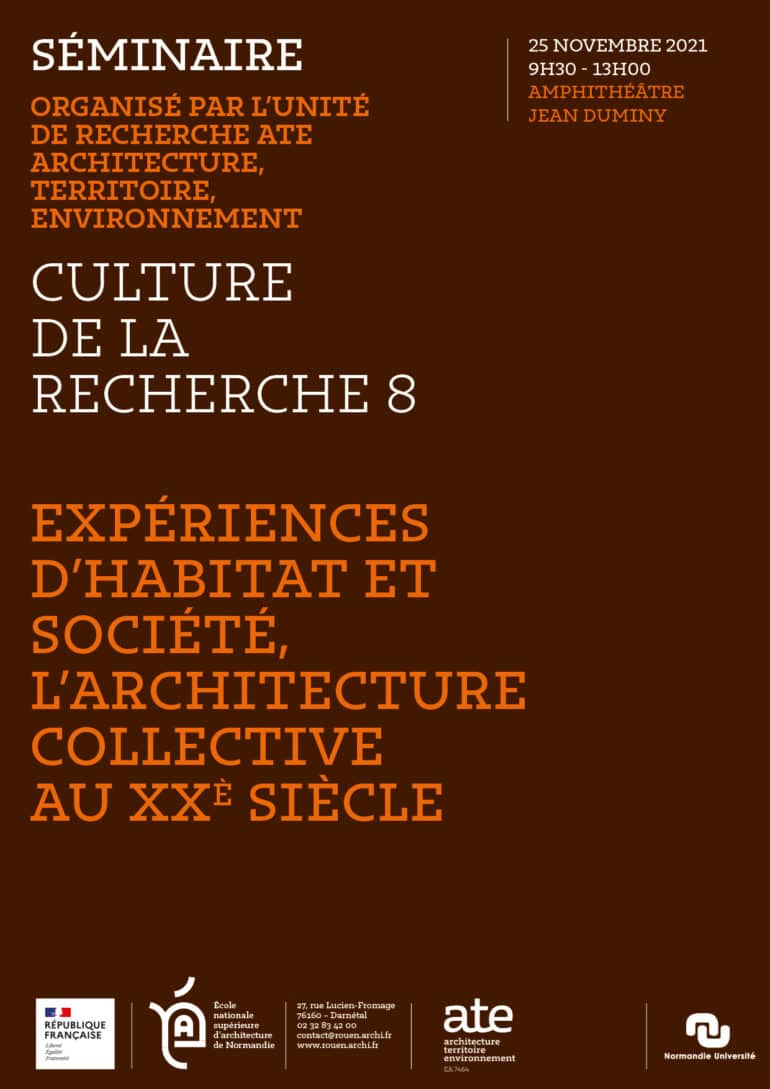
Seminar – Research Culture 7

This seminar is organised by the ATE Laboratory

Download the programme

at 9am online

Doctoral Day - "Living

3rd day of the doctoral school Man, Societies, Risks, Territory.

This day, organised by the doctoral students, aims to offer young researchers in the Humanities and Social Sciences the opportunity to promote their work. It will be dedicated to the issues raised by the notion of inhabiting, which takes many forms depending on the discipline.

Download the programme

Visual: © All rights reserved

The ATE laboratory is looking for a PhD candidate - CIFRE

The Architecture, Territory, Environment Laboratory atENSA Normandie is seeking a candidate for doctoral funding under a CIFRE contract with social housing provider Habitat76 on the following topic: "Low-carbon renovation: what potential for architecture? The case of individual social housing."

The profile sought is that of a young graduate in architecture who is interested in the technical dimensions. An architect-engineer would be perfectly suitable.

Published on

Details of the call for applications

Our territory

Habitat76, the leading social landlord in Normandy, is a partner in this thesis project. It manages more than 30,000 dwellings in nearly 200 municipalities, mainly in the Seine Maritime region. Its head office is located in Rouen, within the Metropolis of Rouen Normandy, which includes 71 communes, 498,822 inhabitants, on a territory of 664 km2. It is the most forested metropolis in France, in a region with significant but little-exploited potential in terms of eco-construction resources: building soil for raw earth construction, agro-resources for insulation (in particular wheat straw, flax), recycling channels, construction wood, etc.
This project is alsopart of several initiatives launched by the Metropolis to reduce its environmental impact in line with the development of short circuits. These orientations, developed in its local COP21, its Territorial Climate Air and Energy Plan, its forestry and agricultural charters for the territory, and the regulations for major urban development operations such as the Rouen Flaubert eco-district, must be reflected in the local housing programme and the strategic asset plans of social landlords.
Up to now, the latter have legitimately given priority to the energy upgrading of collective housing with collective heating. Thus, Habitat 76 has now completed the renovation of 17,000 dwellings in this category, and is now turning its attention to the collective housing stock with individual heating, and then to the renovation of the individual housing stock by 2025-2030. This last corpus represents for this landlord 4500 dwellings, all of which are included in the digital database containing geographical, spatial and technical information. Its Strategic Asset Plan is updated every three years, and the one covering the period 2027-2036 should be finalised by mid-2024, i.e. in synchronisation with the planned end of this thesis project.

The challenge

This research aims to contribute to the development of architectural strategies for intervention projects on existing buildings, in line with environmental concerns. Observatories, characterisation of energy consumption by type, pilot experiments in energy requalification or involvement of the inhabitant, standardised technical solutions; all these studies, which constitute a cumulative knowledge, are largely deaf to architecture.

On the contrary, this project considers that renovation is today the most appropriate place to develop new ideas in architecture, which are the expression of a society that is both environmentally responsible, enthusiastic and innovative. How can the architect seize the concept of positive energy/negative carbon of the future regulations to give it an architectural and not only technical meaning, to relate it to the other challenges of sustainable development such as the local and circular economy or the limitation of waste, to transform it into a generator of ideas for new materialities?
It is a question of opening up to new evaluation criteria, new intervention models, and even new project processes, aiming to reduce the environmental impact of the intervention, that linked to the use of the building, to improve its architectural quality for the benefit of the inhabitant, while remaining as close as possible to the economic and social concerns of the landlord. More specifically, we will examine the potential of eco-materials whose implementation limits the emission of greenhouse gases, grey energy and the production of waste, of materials derived from reuse or renewable, and whose production stimulates the territorial economy. The focus will be on bio-based materials, but also on those with which they can form a coherent system.

Methodology

The project situation used to give substance to the theoretical reflection, to generate the architectural concepts and then to evaluate their potential in terms of expression, atmosphere and efficiency, is that of the renovation of individual housing. Indeed, this category has been little studied until now, although it forms a large corpus, raises specific questions and the results could be transferred to a very large number of private dwellings.

  1. The first action will be to collect and analyse a corpus of exemplary projects in terms of the use of bio-sourced materials and eco-renovation, to stimulate creativity as well as to understand the possibilities and conditions of using local eco-materials.
  2. The second stage will analyse the landlord's corpus of individual social housing, according to a set of criteria likely to renew the major morphoconstructive typologies associated with energy saving opportunities. Beyond the technical characteristics, it will also be a question of evaluating the heritage value, the potentials and stiffnesses of the spatial organisation, the socio-economic and cultural profiles of their occupants.
    This analysis will be confronted with the established know-how of the landlord, in order to extract a limited number of representative buildings, for which the architectural intervention project will be used as a research tool, in order to bring out the problematic issues and evaluate the proposed alternatives. Finally, the critical analysis of this project exercise consists of evaluating the architectural quality a posteriori, according to explicit criteria, such as expression, technical feasibility, quality of atmosphere, energy and economic performance.
  3. Finally, the last action will consist of using all of this work to propose a principle of restitution to the various actors, i.e. architects, landlords and inhabitants.

Applications and information

The arts of architecture - "RADIAL 4

Call for papers - "RADIAL" journal

The call for papers is aimed at researchers and/or practitioners in architecture. It may also include proposals relating to pedagogical practices at the intersection of the arts of architecture. It also concerns philosophers, historians, artists and theoreticians of architecture or art developing research on the intermediary of matter and the sensible, material reality and aesthetics.

Like the RADIAN doctorate in 'research and creation', the aim is to bring theory into line with practice in order to grasp what might be called the 'concrete poetics' of architecture, which, from the beginning of the 20th century to the present day, is woven into the art of construction.

Each issue is organised around a theme and varias, and the graphic design of each issue is entrusted to a different graphic designer.

DEADLINE 30 June 2021 - Download the call for papers

Click hereto see the other magazines

Visual ©Radial 3 cover


Published on

from 9.20 a.m. to 1 p.m.

Seminar – Research Culture 6

This seminar is organised by the ATE Laboratory

Download the programme

Living the architecture of the Reconstruction in Normandy

Virtual exhibition - "It's already old".

The exhibition "It's already old" is a commission of the project "Cultural resources and urban project" which studies the heritage of the Reconstruction in Normandy. "Cultural Resources" is a research project of the National School of Architecture of Normandy (ATE laboratory). It is part of the interministerial research and experimentation programme "Ville du XXe siècle matière à projets pour la ville durable du XXIe siècle" of the Ministry of Culture (BRAUP). The subjective view of the artist reveals the ordinary, extraordinary, suffered, inherited intimacy of the inhabitant: "Reconstruction is already old", "I stay for the view", "no defect except ...", "the potential to transform it", "I will not change anything". In fifteen encounters, "It's already old!" is a humanistic and illustrated panorama of daily life in the housing of the Reconstruction.

Elisabeth Blanchet, photographer and journalist, has built her artistic work on the observation of life paths. She works in particular on post-war barracks in the United Kingdom and in France, with a dimension that is both sensitive and militant.

Visit the exhibition by clicking here

Presentation on Wednesday 16 December 2020 at 14:30 in visiocon

Visual: ©Elisabeth Blanchet

Grand hall ofENSA Normandie

Exhibition - "May 68 - Architecture too!

This exhibition invites us to revisit a field of possibilities, the fifteen years (1962/1977) that saw the renewal of education, along with that of architecture, urban planning and the professions associated with them. The refusal of heritage, or at least its evolution, the reinvention of forms and pedagogical content that followed, and finally the hypotheses that were formulated for society and architecture are the main themes that make it possible to analyse the aspiration to do architecture differently.

Exhibition curators: Caroline Maniaque (ENSA Normandie), Eléonore Marantz (Université Paris 1 Panthéon-Sorbonne) and Jean-Louis Violeau (ENSA Nantes). Set design: Auriane Bernard Guelle.
Based on the original exhibition designed and presented at the Cité de l'Architecture et du Patrimoine for the 50th anniversary of May 1968.

This event was supported by the Ministry of Culture (Bureau de la recherche architecturale, urbaine et paysagère) and the Cité de l'architecture & du patrimoine.

Seminar – Research Culture 5

This seminar is organised by the ATE Laboratory with Caroline Lemans, Lionel Engrand, Patrice Gourbin, Camille Bidaud and Ralph Goche.

Download the programme

The ATE laboratory newsletter

Output - ATE Workbooks n°2

You can find the latest ATE newsletter in the publications kiosk and by clicking HERE.

Published on