Marie Gaimard

HDR Defense – Treating History Like a Game?

On November 27, 2026, at 9:30 a.m., at Paris 1 Panthéon-Sorbonne University, Marie Gaimard, a faculty member and researcher at the ATE laboratory, will defend her Habilitation à Diriger des Recherches (HDR) thesis titled “Treating History as a Game?”

The application dossier consists of three volumes under the title “Treating History as a Game?”:
– Vol. 1: a comprehensive thesis tracing Marie Gaimard’s academic and intellectual journey;
– Vol. 2: a collection of Marie Gaimard’s works and publications;
– Vol. 3: unpublished thesis titled “Raw Architecture: The Unconventional Paths of André Ravéreau.”

The doctoral dissertation will be defended before the following jury:
– Gauthier Bolle, Professor of Architectural History and Culture, École nationale supérieure d’architecture de Strasbourg (rapporteur)
– Leïla el-Wakil, Associate Professor, University of Geneva (examiner)
– Jean-Philippe Garric, University Professor, University of Paris 1 Panthéon-Sorbonne (supervisor)
– Claude Massu, Professor Emeritus, University of Paris 1 Panthéon-Sorbonne (examiner)
– Catherine Maumi, Professor of Architectural History and Cultures, École nationale supérieure d’architecture de Paris-la Villette (examiner)
– Nathalie Simonnot, HDR Research Engineer, École nationale supérieure d’architecture de Versailles (examiner)
– Estelle Thibault, Professor of Architectural History and Cultures, École nationale supérieure d’architecture de Paris-Belleville (rapporteur)

The defense will take placein the Duroselle Room at the Sorbonne Center of Paris 1 Panthéon-Sorbonne University, 14 rue Cujas, 75005 Paris. 

Access to the Sorbonne requires prior, name-based registration. Please fill out the form by November 15 https://forms.gle/y2sRo75Ngr8HjSz39

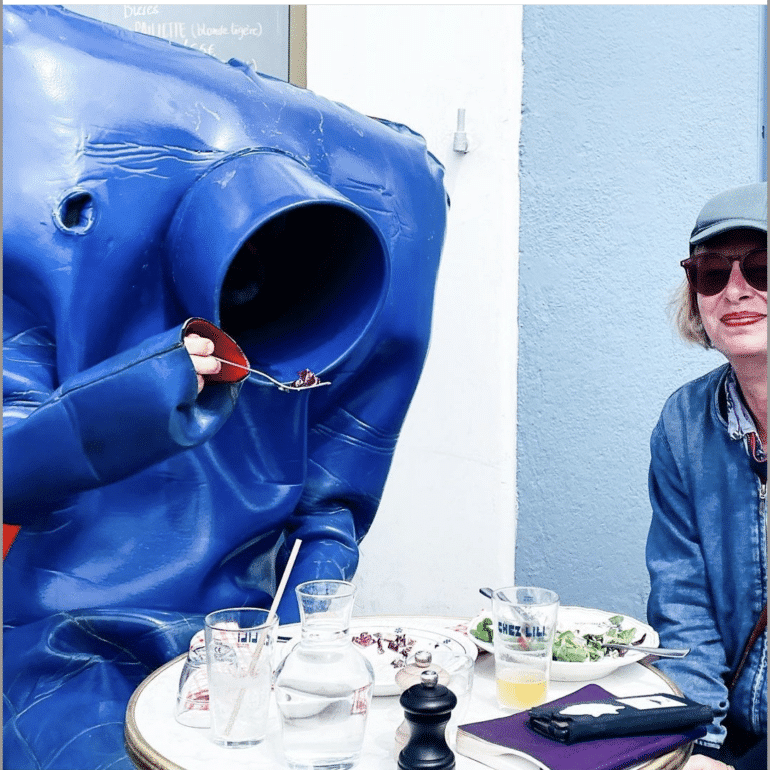
Image: Blueman, Le Havre, 2022

Gabriel Bernard Guelle

Thesis Defense – The Teaching of Construction to Architects Between 1920 and 1970 in France and Germany

On Tuesday, November 24, 2026 , at 2:00 p.m., in the Duminy Lecture Hall, Gabriel Bernard Guelle will defend his doctoral dissertation titled “The Teaching of Construction to Architects Between 1920 and 1970 in France and Germany: Defining and Reforming the Architect’s Relationship with Technology and Engineers.”

This doctoral dissertation was prepared at the ATE laboratory under the supervision of Caroline Maniaque, professor emerita, ENSA Normandie, ATE, and with the co-supervision of Christel Palant-Frapier, associate professor, ENSA Paris-Val-de-Seine, EVCAU.

Jury member

Valérie Nègre, Professor, University of Paris 1 Panthéon-Sorbonne, rapporteur
Estelle Thibault, Professor, École nationale supérieure d’architecture de Paris-Belleville, rapporteur
Pierre Chabard, Associate Professor, École nationale supérieure d’architecture de Paris-La Villette, examiner
Jörn Garleff, Associate Professor, École nationale supérieure d’architecture de Saint-Étienne, examiner
Corinne Jaquand, Professor, École nationale supérieure d’architecture de Paris-Belleville, examiner
Antonella Mastrorilli, Professor, École nationale supérieure d’architecture et de paysage de Lille, examiner

The defense will be streamed live via videoconference HERE

More information HERE

Thesis Abstract

From 1920 to 1970, the architecture departments at the École nationale supérieure des beaux-arts in Paris and the École technique supérieure in Munich reformed their construction curricula in response to the technical, institutional, and professional changes that took place in France and Germany during that period. Despite these reforms, French students and practicing architects continually criticized their construction curriculum for being out of touch with current architectural trends and the realities of professional practice, even though they received more in-depth training in this area than their German counterparts. While recent research on architecture education in France during the 20th century has examined its successive transformations and the reasons behind the collapse of the École nationale supérieure des beaux-arts model in 1968, few scholarly works have focused specifically on construction education, and none have addressed the criticism directed at it. To understand this criticism, this dissertation therefore examines the definition of the architect’s technical knowledge as shaped by construction education, in light of the institutional and professional expectations it is meant to fulfill. Through a comparative historical approach, it examines the content, tools, and methods of construction courses taught to architecture students at the École nationale supérieure des beaux-arts in Paris and the Technical University of Munich, in relation to the technical, institutional, and professional contexts in France and Germany. She thus demonstrates the role of construction education in defining technical knowledge specific to architects and in shaping their relationship to technology and engineers.

Keywords: architecture education, architect, engineer, France, Germany, 20th century, technology, École nationale supérieure des beaux-arts, Technische Hochschule München, history of architecture, history of education, 1920–1970, Paris, Munich

Images:
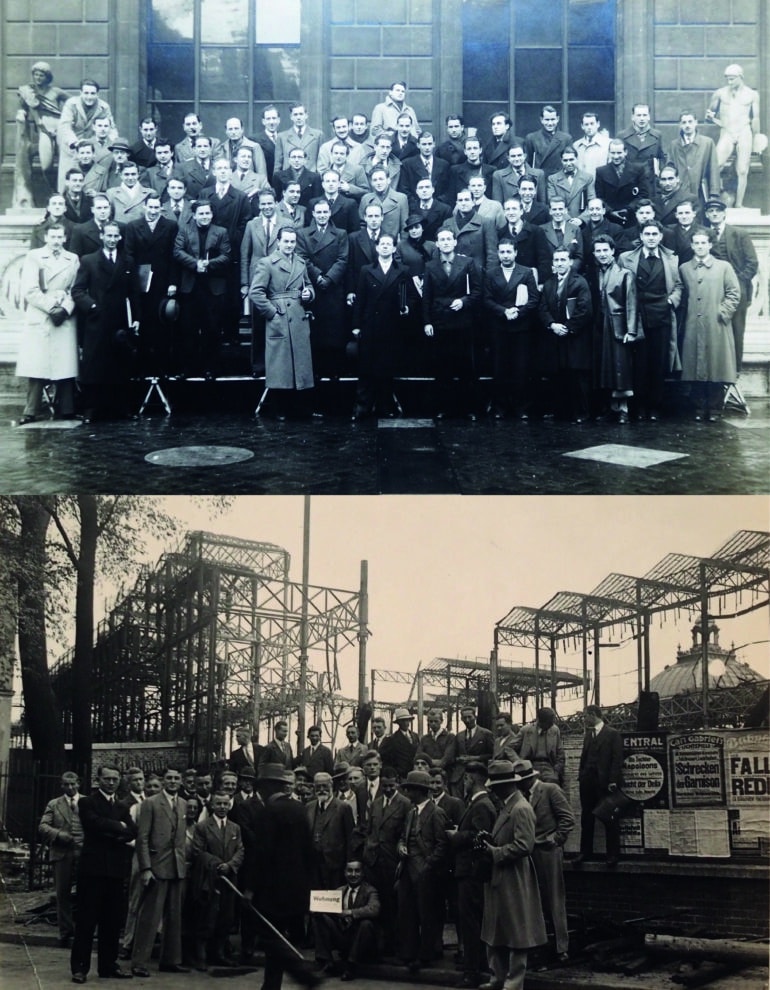
(top) François Vitale, professor of Construction at the École nationale supérieure des beaux-arts in Paris, with his students in front of the school’s library, January 1937. Personal archives of Françoise Boudon.

(bottom) Emil Edler von Mecenseffy, professor of Building Construction at the Technical University of Munich, visiting a construction site with his students, 1931. Archive of the Architecture Museum at the Technical University of Munich, Franz Hart Collection, har-404-1001.

At the Maison de l'Architecture de Normandie—the Forum

Debate – “Beyond the Good and the Beautiful: Architecture of a World in Shambles”

Thursday, November 5, 2026, at 6:30 p.m. –

As part of the international symposium “Goodness and Beauty in Contemporary Architecture” (ENSA Normandie, ATE Laboratory) and the simultaneous publication of the book *Beyond the Good and the Beautiful: Architecture of a World in Pieces (Éditions de la Villette, 2026), the Maison de l’architecture de Normandie – le Forum is hosting a discussion with authors Pierre Chabard, Valéry Didelon, and Pauline Lefebvre, with Jean-Pierre Chupin providing critical commentary.

Find all the information HERE 

Visual © All rights reserved

Symposium – “The Goodness and Beauty of Contemporary Architecture”

On Thursday, November 5, and Friday, November 6, 2026, at the École nationale supérieure d’architecture de Normandie, the ATE Laboratory will host the international conference “Goodness and Beauty in Contemporary Architecture” – Ateliers du Parc (Juliette Billard Room).

Symposium: “The Goodness and Beauty of Contemporary Architecture”

After several decades marked by formalist approaches, the focus of evaluations of buildings has shifted increasingly increasingly based on ethical considerations. Buildings are expected to be good for humans and non-humans alike—and, beyond that, for the environment. However, these buildings are still subject to aesthetic judgment, and they are therefore expected to be beautiful rather than ugly, even though opinions may differ on what constitutes beauty in architecture.
The symposium“Goodness and Beauty in Contemporary Architecture”offers an opportunity to explore how goodness influences beauty (and perhaps vice versa). To what extent do ethical considerations—such as the good life, the well-being of residents and users, and environmental preservation—contribute today to the renewal of architectural aesthetics? What should we make of projects that seek to be overt or demonstrative in this regard, even at the risk of sometimes leaving themselves open to accusations of greenwashing? And conversely, what about ecological approaches that remain invisible once the buildings are constructed? More fundamentally, what interactions exist between the realms of ethics and aesthetics in the evaluation of architecture?

Download the program and abstracts HERE

The conference will be streamed via videoconference at the following links:
THURSDAY, NOVEMBER 5
– MORNING: Introduction and Imperfections HERE
– AFTERNOON: Theoretical Systems HERE
FRIDAY, NOVEMBER 6
– MORNING: Session 3 – The Inhabiting Prism HERE
– AFTERNOON: Session 4 – Mediations and Conclusion HERE

The symposium “The Goodness and Beauty of Contemporary Architecture” is organized by the ATE Research Laboratory, with support from the Ministry of Culture.

Organizing Committee:
Valéry Didelon, Professor ENSA Normandie, Research Director, ATE Laboratory
Guillaume Nicolas, Associate Professor ENSA Normandie, Researcher at the ATE Laboratory

Coordination:
Claire Rosset, Research Engineer, ENSA Normandie, researcher at the ATE laboratory

Scientific Committee: 
Pierre Chabard, Associate Professor, ENSA Paris-La Villette; Researcher at the AHTTEP Laboratory
Jean-Pierre Chupin, Professor, University of Montreal; Canada Research Chair in Architecture, Competitions, and Quality (CRC_ACQUA)
Valéry Didelon, Professor ENSA Normandie, Research Director at the ATE Laboratory
Pauline Lefebvre, Researcher at the Faculty of Architecture, Université libre de Bruxelles (ULB)
Guillaume Nicolas, Associate Professor ENSA Normandie, Researcher at the ATE Laboratory
Estelle Thibault, Professor at ENSA Paris-Belleville, Research Director at the IPRAUS Laboratory


Image: photograph © Paul Smoothy

Guillaume Nicolas

Thesis Defense – Agriculture Is a Battlefield, and Architecture Bears Witness to It

Monday, October 12, 2026 , at 2:00 p.m., in the Duminy Lecture Hall, Guillaume Nicolas will defend his doctoral dissertation titled “Agriculture Is a Battlefield, and Architecture Bears Witness: An Investigation into the Transformations of Norman Clos-Masures.”

This doctoral dissertation was prepared at the ATE laboratory under the supervision of Valéry Didelon, professor, ENSA Normandie, ATE.

Jury member

Isabelle CHESNEAU, Professor, ENSA Paris-Malaquais (Reviewer)
Sébastien MAROT
, Professor, ENSA Paris-Est (Reviewer)
Matthieu CALAME
, Ph.D. (Examiner)
Sandra FIORI
, Associate Professor, ENSA Lyon (Examiner)
Philippe MADELINE
, Professor, University of Caen Normandy (Examiner)

The defense will be streamed live via videoconference HERE

Thesis Abstract
With the widespread adoption of motorized machinery and chemical inputs, the second agricultural revolution of modern times profoundly transformed farmers’ practices after World War II. Today, in an era of ecological disruption and geopolitical instability, the French government is promoting a third revolution—one centered on digital technology, robotics, and genetics. Co-managed by the state and the dominant farmers’ union, the FNSEA, these modernization policies are affecting the structure of traditional farm operations, where most farmers continue to work. Yet, a segment of the agricultural community is concerned about the consequences for the profession and, more broadly, for rural communities. The Confédération paysanne in France and La Via Campesina internationally advocate for different collective choices and embody a structured alternative, both technically and socially. Agriculture has now become a battleground, polarized between an industrialized path and a contemporary peasant path. The hypothesis of this research is that architecture reflects an ideological clash that goes beyond the mere technical-economic orientations of farms (OTEX) as defined by INSEE. To study this phenomenon, the field survey conducted here among some forty farmers in Normandy establishes a new category—the political orientation of farms (OPEX)—and analyzes how this influences the architecture of farmsteads. More generally, this research uncovers the reasons that, beyond purely utilitarian considerations, dictate how farmers shape their built and landscape heritage. The farms observed all belong to the same historical type found in the Pays de Caux—the “clos-masure”—which possesses both a strong regional identity and a certain flexibility for adaptation. The study of the transformations of these vernacular buildings and landscapes reveals the changes currently underway and helps to clarify what architecture says about agriculture—and sometimes also what it does to it—on functional, material, and aesthetic levels.

Keywords: industrial agriculture, small-scale farming, agricultural architecture, vernacular, heritage, decision-making, clos-masure, Normandy, survey, controversy

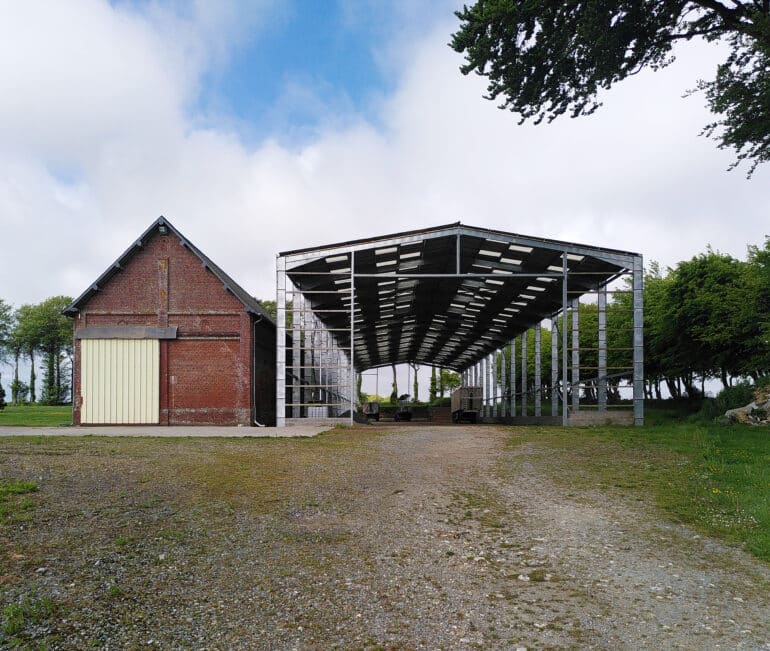
Photo: Agricultural barn under construction in a "clos-masure" © Guillaume Nicolas

Benoît d'Almeida, Luc Perrot, and Claire Rosset

[Online] Roundtable Discussion – Living with Water: Why Not?

On June 23, 2026 ,Benoît d’Almeida, Luc Perrot, and Claire Rosset were invited byUniversité Buissonnière (University of Rouen Normandy) to lead a roundtable discussion on the topic “Living with Water: Why Not?”

The “Sous la pluie” Buissonnière University was the third edition of these events organized by the Department of Culture and the T.URN Institute. An invitation to slow down, observe, and rethink our relationship with the world, bridging the gap between sensory experience and scientific understanding.

The roundtable discussion “Living with Water: Why Not?” was moderated by Alexandre Legay. It brought together architects, artists, and researchers to explore water not as a constraint, but as an ally.

You can watch the video recording of this online discussion HERE!


Published on

Misia Forlen

Thesis Defense – Living in the Zone

On Wednesday, July 8, 2026, at 10:30 a.m. and again at 2:30 p.m., Misia Forlenwill defend her doctoral dissertation titled “Inhabiting the Zone: Observing, Filming, and Understanding the Daily Practices of Mobile Workers in Special Economic Zones (SEZs).”

This doctoral dissertation was completed at the University of Le Havre Normandy as part of the RADIAN program (Research in Art, Design, Innovation, and Architecture in Normandy), under the supervision of Arnaud Le Marchand (CNRS UMR IDEES 6266 – University of Le Havre Normandy) and Bruno Proth (ATE – École Nationale Supérieure d’Architecture de Normandie).

The defense will take place on Wednesday, July 8, 2026, in two parts:
– at 10:30 a.m.: presentation of a film and cartographic installation at the Le Havre Port Center (panoramic room), Terminal de la Citadelle, 76600 Le Havre. Refreshments will be served starting at 10:15 a.m.
– at 2:30 p.m.: thesis defense, at the University of Le Havre Normandy (International Affairs Building, Lecture Hall 4), 25 rue Philippe-Lebon, 76600 Le Havre.

Jury member

Marc BERNARDOT, Full Professor, Aix-Marseille University, Thesis Advisor
Florence BOUILLON, Associate Professor, Paris 8 University Vincennes St-Denis, Examiner
Catherine DESCHAMPS, Full Professor, ENSA Paris La Villette, Thesis Advisor
Lucinda GROUEFF, Assistant Professor, ENSP Versailles, Examiner
Anne JARRIGEON, Associate Professor (HDR), Gustave Eiffel University, Examiner
Laëtitia OVERNEY, Full Professor, University of Le Havre Normandy, Chair of the Committee

Thesis Advising

Arnaud LE MARCHAND, University Professor, University of Le Havre Normandy, Thesis Co-Advisor
Bruno PROTH, University Professor, ENSA Normandie, Thesis Co-Advisor

Thesis Abstract
“Habiter la zone” is a research-creation project that examines the daily practices of mobile workers in Special Economic Zones (SEZs), models of free trade zones that function as economic and fiscal enclaves. At the intersection of the social sciences, architecture, and the visual arts, this dissertation explores forms of creative expression that, in turn, inform research on inhabiting spaces, in relation to changes in work and industrial territories. Developed within the RADIAN doctoral program (Research in Art, Design, Innovation, Architecture in Normandy), this doctoral project is structured around several components: a theoretical dissertation, audiovisual works, and a field journal in the form of an interactive, evolving online map that allows for the spatial representation of observations, reflections, and hypotheses, as well as images and sounds, resulting from this hybrid process of research and creation.
Rooted in an empirical, field-based approach, the research documents little-known situations of housing insecurity in and around industrial employment hubs in both France and Poland. It takes as its starting point a study of Port-Jérôme-sur-Seine, where a project has been in place since February 2018 . This unique territorial and economic context is then placed in perspective with other contexts exhibiting similar characteristics, in order to establish connections and comparisons at various scales—metropolitan, regional, and European. The filmmaking approach must therefore constantly adapt to the specific challenges and constraints of the various study sites: at a Grand Paris Express construction site, it allows for an examination of the processes of metropolization along the Seine corridor, as well as the constraints associated with filming and distributing a documentary; in Flamanville, footage shot in various everyday settings frequented by people working on the EPR construction site allows us to examine relationships with family and the role of women in displacement; in Poland, YouTube videos created by foreign female workers offer new perspectives for considering the digital living space as a meaningful scale of analysis. Audiovisual productions, viewed as an active process of research and creation, help address the challenges of representation linked to the invisibility of these areas, as well as of those who live there and shape them.

Keywords: ways of living, daily life, blue-collar work, geographic mobility, industrial region, special economic zone, gender, video, research-creation.

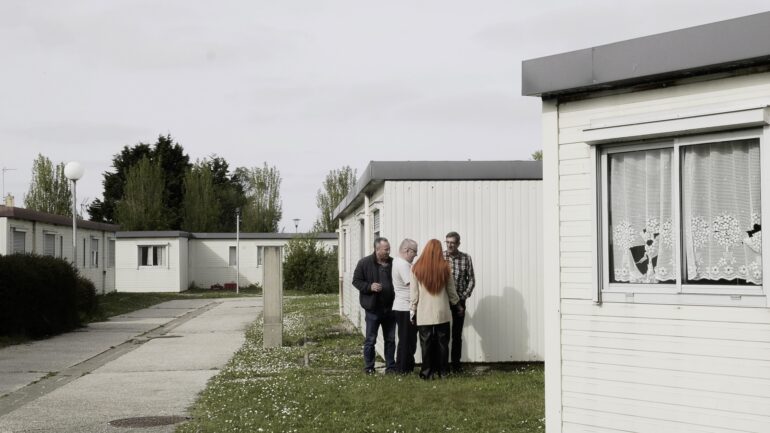
Image: Living in the Area © Misia Forlen

ATE Fanzine

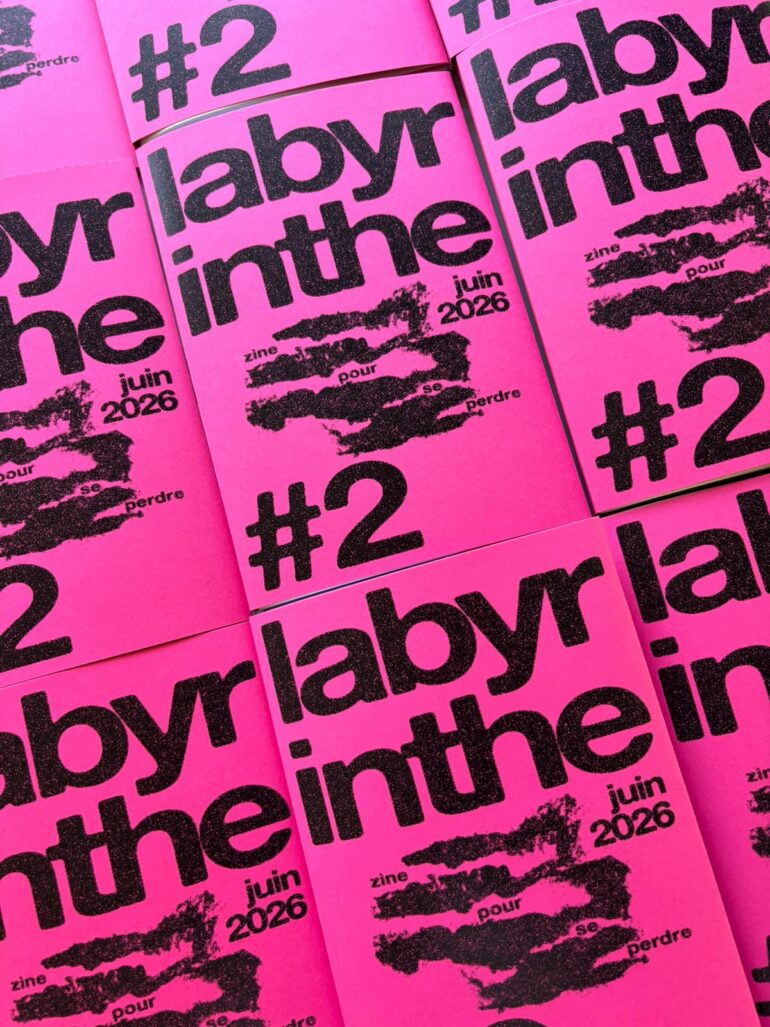
Release – Labyrinth #2

The latest issue of Labyrinthe magazine was released on June 8: The Beautiful, the Raw, and the Living.

In 2023, a shared desire to create a space for expressing doubts, questions, and diverse perspectives gave rise to the “Labyrinthe” fanzine project, launched by a group of doctoral students at the ATE laboratory atENSA Normandie. This shared commitment to sharing and promoting an exploratory approach subsequently expanded, bringing together researchers, faculty, students, architects, and artists within this dynamic of critical engagement.

Following the first two issues published in December 2023 and March 2025, this publishing project once again draws on the image of the labyrinth—a place of wandering or strolling, of hostility or refuge—symbolizing this reflective process that invites us to evolve and transform ourselves, both individually and collectively. This new issue invites us to explore the triad of the BEAUTIFUL, the RAW, and the LIVING, by questioning the boundaries of these categories, their implications, their synergies, and their contradictions.

The journals are available free of charge at the ENSA library. For more information: labyrinthe-zine@protonmail.com

See you in the fall for the launch of this latest issue, published on June 8!

***

Contents of Issue #2 – June 2026: Editor’s Note / *The Brutalist*, by Miléna Koutani / *Précieux*, by Chloé Boudet / A Weekend in Graveling, by Bertrand Verney / Bonnibel’s Stroll, by Léna Tullifer / There Will Be Wood, by Espace Disponible / The Motionless Giants, by Mathilde Sigrist / The Fort of Haut Bug: A Hypothesis of Building with the Living, by Félix Cavadini and Mathis Joulin / Journal of the Sky: Celestial Correspondence, by Laure Brayer and Claire Rosset

Editorial team: Antoine Apruzzese, Lucie Dehame, Alexis Desplats, Miléna Koutani, Léna Tullifer

LINK TO THE FANZINE'S WEBSITE HERE

Published on

Call for Applications 2026 – RADIAN Doctorate in Artistic Research and Creation

Through June 29, 2026 –

Normandy's three cultural colleges - the Le Havre-Rouen College of Art and Design, the Caen/Cherbourg College of Arts & Media, and the Normandy National College of Architecture - members of the Normandie Université Community of Universities and Institutions, and the Doctoral School 558 "Normandie Humanités" have created in 2018 RADIAN, a doctorate in artistic research and creation open to the fields of art, design, architecture and creative writing(more information HERE).

The call for applications for the RADIAN 2026 program is now open.

“Contemporary Creation” and “Architecture” categories – Applications must be submitted by 11:59 p.m. on June 29, 2026 – online only. Oral interviews with eligible candidates and announcement of results on Tuesday, October 13, 2026, in Caen.

More information on the call and the application process HERE.

visual : all rights reserved

Published on

Noura Arab, François Fleury, and François Streiff

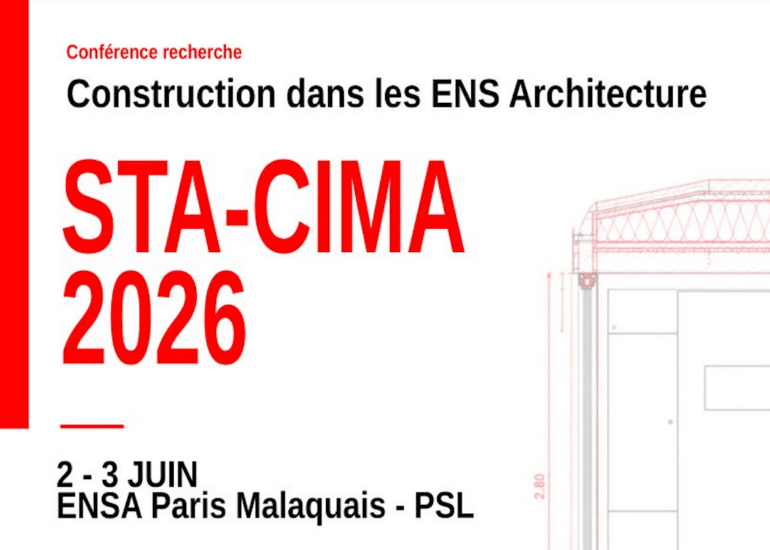
Construction Research Conference – STA-CIMA 2026

On Tuesday, June 2, and Wednesday, June 3, 2026, at ENSA Paris Malaquais the conference “Research in Construction at ENSA-P: STA-CIMA 2026” will take place.

This new edition features 35 presentations and 11 posters on current issues in construction, engineering, and environmental management research at ENSA-P.

ATE researchers will be attending this event:

– Noura ARAB, with a presentation titled “Resources for ecological architecture: materials, climate, and existing
as the foundations of a renewed building culture”;

– François FLEURY, with a presentation titled “Architecture and Comprehensive Insurance.”

– Noura ARAB and François FLEURY will also present the poster on the“RNRCA Chair: Renewable Natural Resources, Climate, and Architecture”;

– François STREIFFwill present a poster on the “CoBauge” project.

More information HERE. 

Registration is required: https://lnkd.in/eY_e4wfa

Image: Poster for the STA-CIMA 2026 Conference