The ATE laboratory is organizing an international symposium on April 20 and 21, 2023, atENSA Normandie "What architecture does for ecology."
This colloquium aims to question the possible feedback effects: if ecology - understood here as science, but above all as ethics of action - undoubtedly changes architecture, to what extent does architecture also change ecology? This question arises in relation to the concrete achievements in which architects and assimilated (engineers, urban planners, landscape architects, etc.) engage, but also in relation to the doctrines and theories they formulate.
The symposium will contribute to the scientific and public debate through 14 original papers gathered in 4 thematic sessions, one of which is in English.
6:00-7:00 p.m. - April 20, 2023: public lecture by Lionel Devlieger
Jean-Duminy Amphitheater
A public lecture entitled "Ecology and Disciplinary Decompartmentalization" will be given on Thursday, April 20 by Lionel Devlieger, professor at the Universiteit Gent (Belgium), member of the scientific committee of the conference.
The conference is open to all, free of charge, without registration. No remote transmission is planned.
Download the conference program.
Download the abstracts of the presentations.
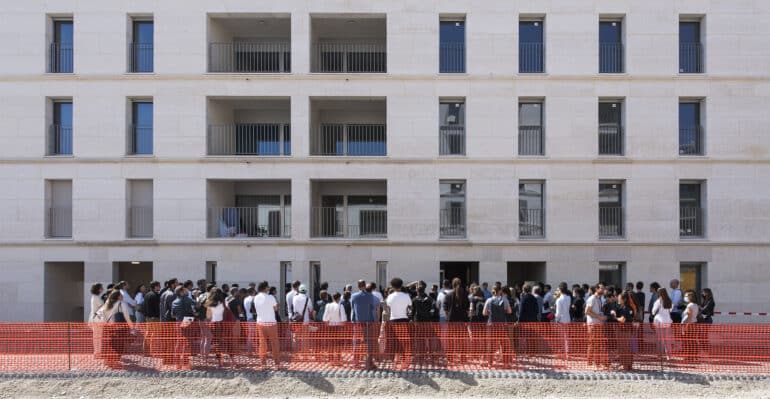
visual: Solid stone apartment building, Plan-les-Ouates (Switzerland) - Architects: Atelier Archiplein and Perraudin Architecte © Hélène Maria photographe - Archiplein